Meshy Raises Nearly $400 Million at a $1.5 Billion Valuation, the Largest Round to Date in AI 3D
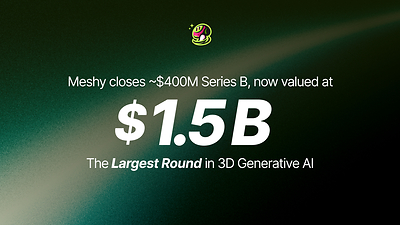
SILICON VALLEY, Calif., July 21, 2026 /PRNewswire/ -- Meshy, a company building foundation models for AI-powered 3D generation, today announced it has raised nearly $400 million in a Series B round at a $1.5 billion valuation. It is the largest funding round to date for a company built specifically for AI 3D. The round was backed by a group of leading global investors, with participation from all existing investors. It is also Meshy's first publicly disclosed valuation.
Meshy has made 3D creation dramatically simpler. From a single line of text or one image, users can generate a usable 3D model in about a minute. Work that once took specialized skills, expensive software, and weeks now takes about a minute and a dollar. As of July 2026, the company's annual recurring revenue is growing about 12x year over year, with more than 12 million registered users and over 100 million models created. In a field where most companies have yet to reach meaningful revenue, Meshy has built its lead on real commercial performance.
On the technology side, Meshy has advanced AI-generated 3D from "looking right on screen" to "ready for real production." Its models are usable directly in games and, increasingly, printable as physical objects - the company's core differentiator. Meshy is introducing several product updates:
- Meshy 3D Agent: The world's first AI agent for 3D creation. Meshy 3D Agent turns a conversation, a line of text, a photo, or a sketch into a print-ready 3D model in formats including FBX, OBJ, GLB, and STL, with no prior 3D experience required. It brainstorms ideas, generates concepts in batches, turns a chosen concept into a 3D model in a single step, and answers 3D questions through built-in Q&A. For 3D printing, it achieves a slicer success rate of up to 97%; for game development, it exports models compatible with Unity, Unreal, and Blender. Meshy 3D Agent is now available to all registered users.
- Auto Split: One-click part-splitting for 3D printing. The hardest step in 3D printing is often breaking a model into parts that can be printed and reassembled. After a model is generated, Auto Split performs this step in a single click, automatically repairing surfaces and arranging parts on the print bed. Each part is a closed, watertight solid; seams are placed along concealed boundaries to preserve the model's appearance; the parts reassemble precisely into the original; and the layout is print-ready for immediate download. Auto Split produces the most reliable, genuinely assemblable parts in the category—verified on physical 3D printers—whereas output from other tools is typically color-segmented for on-screen display and falls apart in the real world. Auto Split is now available to all registered users.
- Smart Topology: Meshy's latest in-house model. Smart Topology generates a 3D model with native, cleanly structured geometry in about 10 seconds, with a controllable polygon count from 100 to 15,000. Compared with the previous generation, it delivers clear gains in generation speed, polygon control, and topology, making it well suited to game development, interactive web, and other real-time rendering projects. Smart Topology is now available to all registered users.
- 8K Texture: High-resolution texture generation. Meshy can now generate 8K-resolution textures with clean color reproduction and rich surface detail. Meshy's 8K Texture is rolling out soon.
Meshy's reach already extends to the very top of the global economy: five of the world's ten largest technology companies by market capitalization or valuation have teams building with Meshy. Meshy is also widely used across gaming, 3D printing, design, and the cultural sector. Its customers and partners include leading game companies such as Nexon, NetEase Games, and 37 Interactive Entertainment; top 3D printing brands including Bambu Lab, Creality, Elegoo, FlashForge, and xTool; and globally recognized names such as Hugo Boss and Sweden's museum of art and design.
That performance did not come from technology alone. Like many companies opening a new category, Meshy initially had to find the market its technology fit. As its models generalized and its understanding of users deepened, the company opened new use cases and revenue streams, turning a research lead into a durable commercial one.
Proceeds from the round will be used primarily for R&D and global market expansion.
Over the longer term, Meshy aims to lower the barrier to creation. The desire to create is innate to everyone: from the earliest paintings on cave walls to a video shot on a phone today, that impulse has never changed, only the difficulty of acting on it. Turning imagination into something real once demanded rare skill, costly tools, and significant time, and each advance in technology has made it easier.
Meshy is dedicated to unleashing that instinct in everyone, driving the gap between imagination and reality ever closer to zero. Today, anyone can generate a single 3D object on Meshy. In time, what people create will be an experience they can be immersed in, genuinely feel, and remember afterward. 3D is the starting point, and the domain in which Meshy has already proven its technology and built a real business. Extending that path further is the company's objective.
About Meshy
Founded by MIT PhD Ethan Hu, Meshy is on a mission to make 3D creation accessible to everyone, serving more than 12 million registered users worldwide. Learn more at meshy.ai.
 View original content to download multimedia:https://www.prnewswire.co.uk/news-releases/meshy-raises-nearly-400-million-at-a-1-5-billion-valuation-the-largest-round-to-date-in-ai-3d-302828413.html